When you think of Microsoft, you probably picture Windows, Office, Xbox, or maybe even Bill Gates. But here is a question most people have never stopped to ask: who actually owns Microsoft?
The answer is more interesting than you might expect. Microsoft is not owned by a single person, a family, or a small group of executives. Instead, it is one of the most widely held companies in the world, with ownership spread across millions of investors, massive financial institutions, and a small group of well-known individuals.
Table of Contents
This article unravels the full picture. We will explore who owns Microsoft today, who used to own it, the key figures behind its rise, and what this ownership structure means for the company and the wider tech industry.
Overview of Microsoft
Microsoft Corporation is one of the largest companies on Earth. Founded on April 4, 1975, in Albuquerque, New Mexico, by Bill Gates and Paul Allen, it is now headquartered on the Microsoft campus in Redmond, Washington. The company makes everything from operating systems and productivity software to cloud services, gaming consoles, and artificial intelligence platforms.
Microsoft trades on the Nasdaq under the ticker symbol MSFT and is a component of major indexes including the Nasdaq-100, the Dow Jones Industrial Average, the S&P 100, and the S&P 500. As of fiscal year 2025, Microsoft reported revenue of approximately $281.7 billion, placing it among the most valuable companies ever created.
Importance of Understanding Ownership
You might wonder why ownership matters. After all, if you use Windows or Word, does it really matter who holds the shares behind the scenes?
It actually matters a great deal. Ownership shapes how Microsoft makes decisions, how it allocates billions of dollars in investments, and how it responds to social and political pressures. Major shareholders can influence the board of directors, push for strategic changes, and vote on important corporate matters. Understanding who owns Microsoft helps investors, employees, and customers see the bigger picture of how this tech giant operates.
Current Ownership Structure
Microsoft is a publicly traded company, which means its ownership is divided into billions of shares held by countless investors. These shares fall into three broad categories: institutional investors, individual shareholders, and insiders such as executives and board members.
Major Shareholders
The biggest owners of Microsoft are not individuals they are massive investment firms that manage trillions of dollars on behalf of pension funds, mutual funds, exchange-traded funds, and everyday retirement accounts.
The two largest holders are Vanguard Group and BlackRock. Together, these two institutional giants control a significant percentage of Microsoft’s outstanding shares. Other major institutional holders include State Street Corporation, Fidelity Management & Research, Geode Capital Management, T. Rowe Price, and Capital Research Global Investors.
These firms do not own Microsoft in the traditional sense they hold shares on behalf of millions of individual clients. When you contribute to a retirement fund or invest in an S&P 500 index fund, a tiny slice of Microsoft is technically owned by you through that investment.
Institutional Investors
Institutional investors collectively own roughly 70 to 75 percent of Microsoft’s shares. This is a remarkable level of institutional ownership, and it reflects Microsoft’s status as a foundational holding in nearly every major investment portfolio worldwide.
BlackRock alone manages around $14 trillion in assets as of 2025, making it the world’s largest asset manager. A meaningful chunk of that money is held in Microsoft stock. Vanguard, which pioneered low-cost index investing, holds Microsoft shares across thousands of its mutual funds and ETFs.
This means that if you own almost any broad-market index fund whether through your employer’s 401(k), an IRA, or a brokerage account you likely own a small piece of Microsoft without even realizing it.
Individual Stakeholders
The remaining 25 to 30 percent of Microsoft is owned by individual investors and company insiders. Individual investors include retail traders, long-term shareholders, and high-net-worth individuals who own MSFT stock directly. Insider ownership includes shares held by current and former executives, board members, and the company’s founders.
While insider ownership is relatively small as a percentage, the people involved are some of the most influential names in technology and philanthropy.
Microsoft Corporation’s Ownership
To really understand who owns Microsoft now, it helps to look at how ownership has evolved over the decades.
Historical Context
In the early days, Microsoft was essentially owned by its two founders, Bill Gates and Paul Allen. After the company went public in March 1986, ownership began to spread to investors around the world. Bill Gates, however, remained the largest individual shareholder for many years, at one point owning nearly half the company.
Throughout the 1990s and 2000s, Microsoft expanded rapidly, and its share price soared. As the company grew, its ownership became increasingly diversified. Major mutual funds, pension funds, and sovereign wealth funds began accumulating large stakes. Bill Gates gradually reduced his personal holdings to fund the Bill & Melinda Gates Foundation and to diversify his wealth.
Paul Allen, who left Microsoft in 1983 due to illness, also retained a significant stake until his death in 2018. His shares were transferred to his estate and have since been managed through related entities.
Recent Changes in Ownership
In recent years, Microsoft’s ownership has continued to shift. Institutional ownership has grown as more retirement savings flow into index funds. Bill Gates’s personal stake has dropped to a small fraction of what it once was, partly because of his ongoing transfers to charitable causes and partly due to estate-planning moves.
Microsoft’s acquisition of Activision Blizzard in 2023 and its continued expansion in cloud computing and artificial intelligence have attracted even more institutional interest. As the company’s market value has grown to multi-trillion-dollar levels, the pool of investors holding MSFT has expanded along with it.
Key Figures Behind Microsoft
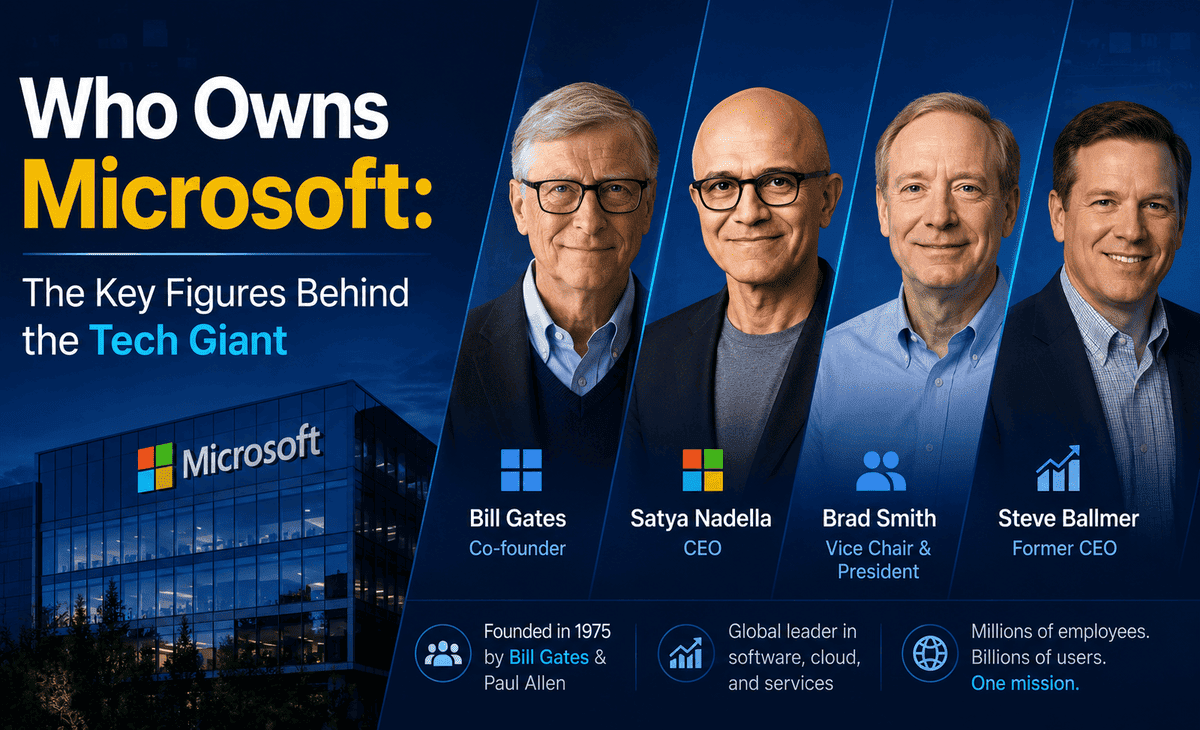
While millions of investors collectively own Microsoft, a small group of key figures has shaped the company more than any others.
Bill Gates
Role in Founding and Early Growth
Bill Gates co-founded Microsoft with Paul Allen in 1975 and served as CEO until 2000, then continued as chairman until 2014. Under his leadership, Microsoft became the dominant force in personal computing, putting Windows on more than 90 percent of the world’s PCs.
Gates stepped down as chairman of the board in 2014 and became technology adviser to CEO Satya Nadella and other Microsoft leaders, a position he still holds. He resigned from the board in 2020. Today, his Microsoft holdings make up only a small percentage of his overall wealth, but he remains one of the most recognizable figures associated with the company.
Most of Gates’s fortune is now directed toward the Bill & Melinda Gates Foundation, the world’s largest private charitable organization, focusing on areas including health, education, and poverty alleviation. A separate entity called Cascade Investment, L.L.C., headquartered in Kirkland, Washington and controlled by Bill Gates, manages the bulk of his personal wealth outside Microsoft shares.
Satya Nadella
Current CEO and Shareholding
Satya Narayana Nadella, born August 19, 1967, is an Indian-American business executive who serves as both chairman and chief executive officer of Microsoft. He succeeded Steve Ballmer in 2014 as CEO and John W. Thompson in 2021 as chairman.
Nadella is widely credited with transforming Microsoft from a Windows-focused company into a cloud computing and AI powerhouse. Under his leadership, Microsoft acquired LinkedIn, GitHub, and Activision Blizzard, and made huge investments in OpenAI and generative AI.
As CEO and chairman, Nadella owns a meaningful personal stake in Microsoft, primarily through stock-based compensation. While his ownership percentage is small in absolute terms, his shares are worth hundreds of millions of dollars and reflect his deep alignment with the company’s long-term success.
Other Notable Stakeholders
A few other individuals also hold significant Microsoft positions. Steve Ballmer, the former CEO who succeeded Bill Gates and led the company from 2000 to 2014, retained a large personal stake after stepping down. He is often cited as one of the largest individual shareholders of Microsoft today.
Brad Smith, Microsoft’s vice chairman and president, holds a notable insider position and plays a major role in the company’s legal, public policy, and corporate strategy decisions. Other board members and senior executives also own shares as part of their compensation packages.
Investor Analysis
Now that you know who owns Microsoft, it is worth understanding why so many investors want to own a piece of it.
Why Own Microsoft Stock?
Microsoft is one of the most attractive long-term investments in the world for several reasons. First, the company has multiple strong revenue streams Azure cloud services, Microsoft 365 subscriptions, Windows licensing, LinkedIn, gaming, and AI services which reduce its dependence on any single product. Second, Microsoft has a strong balance sheet, with substantial cash reserves and minimal debt relative to its size. Third, the company pays a consistent dividend that has grown steadily for years, making it appealing to income-focused investors.
Microsoft is also one of the few companies sitting at the center of the AI revolution. Its partnership with OpenAI and its integration of AI features across products like Copilot have positioned it as a leader in what could be the most transformative technology shift of the decade.
Market Performance Overview
Microsoft consistently ranks among the world’s most valuable companies by market capitalization. Its stock has delivered impressive long-term returns, far outpacing most major indexes over the past decade. The company has been part of the exclusive group of businesses to surpass the $1 trillion, $2 trillion, and $3 trillion market cap milestones joining Apple, Nvidia, and a handful of others.
The combination of steady earnings growth, recurring subscription revenue, and forward-looking investments in cloud and AI has made MSFT a core holding in almost every diversified portfolio.
Conclusion
Summary of Ownership Insights
So who owns Microsoft? The honest answer is that no single person or entity owns the company. Microsoft is collectively owned by millions of investors around the world, with the largest blocks held by major institutional investors like Vanguard, BlackRock, and State Street. Insiders like Satya Nadella, Steve Ballmer, and Bill Gates hold smaller but still substantial positions that align them with the company’s success.
This ownership structure is a hallmark of mature, large-cap public companies. It distributes risk, ensures professional oversight, and creates an environment where decisions are accountable to a wide and diverse group of stakeholders.
Future Ownership Trends
Looking ahead, several trends are likely to shape Microsoft’s ownership in the coming years. Institutional ownership will probably continue growing as passive investing through index funds and ETFs becomes even more dominant. Bill Gates’s remaining personal stake will likely keep shrinking as he transfers more wealth to philanthropic causes. Insider ownership patterns will evolve as new leaders earn stock-based compensation and existing leaders eventually retire.
Whatever happens, Microsoft will remain one of the most widely owned and closely watched companies in the world. Whether you own MSFT directly, through an index fund, or through your retirement account, chances are you have a small but real stake in this technology giant.
Understanding who owns Microsoft is not just a fun fact it is a window into how modern public companies work, how wealth is distributed in the global economy, and how the decisions made in Redmond ripple out to affect billions of people every day.